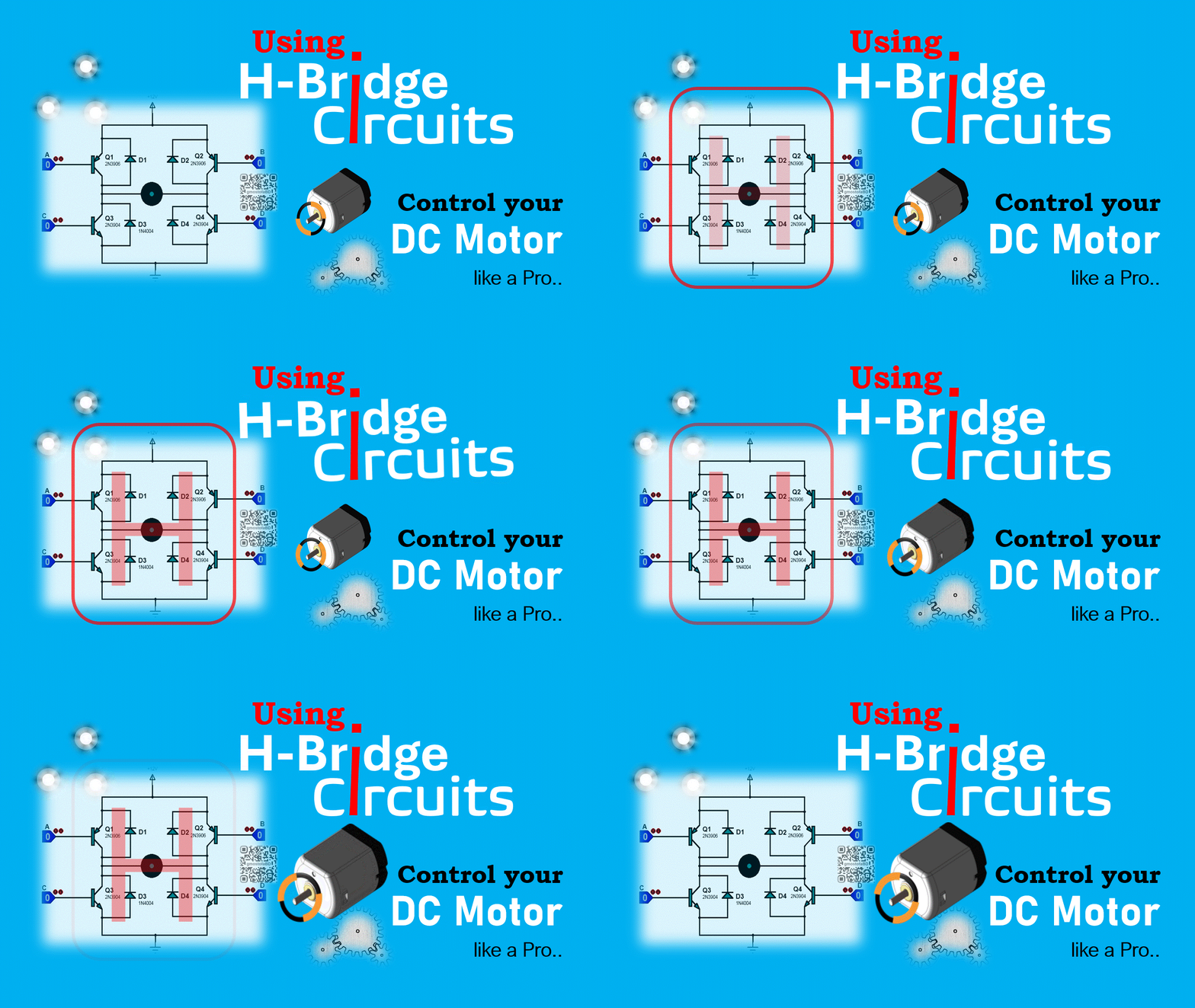
🛠️ H-Bridge Circuits

The H-Bridge Circuit is essential for controlling the speed and direction of DC motors. It is named after its unique "H" shape configuration and is widely used in robotics, embedded systems, and automation projects. The circuit enables smooth motor rotation in both forward and reverse directions by switching the current flow across the motor.
⚡ Introduction to H-Bridge Circuits

An H-bridge circuit is an electronic circuit that allows a voltage to be applied across a load (typically a DC motor) in either direction. This circuit is used to control the direction of the motor's rotation by switching the polarity of the current flowing through it.
🛠️ Basic Components of an H-Bridge Circuit
- Switches (Transistors or MOSFETs): Four switches control the flow of current through the motor.
- Diodes (Flyback Diodes): Protect the circuit from voltage spikes caused by the motor.
- Power Supply: Provides the necessary voltage for the motor.
- Motor: The DC motor acts as the load in the circuit.
🛠️ How the H-Bridge Circuit Works:
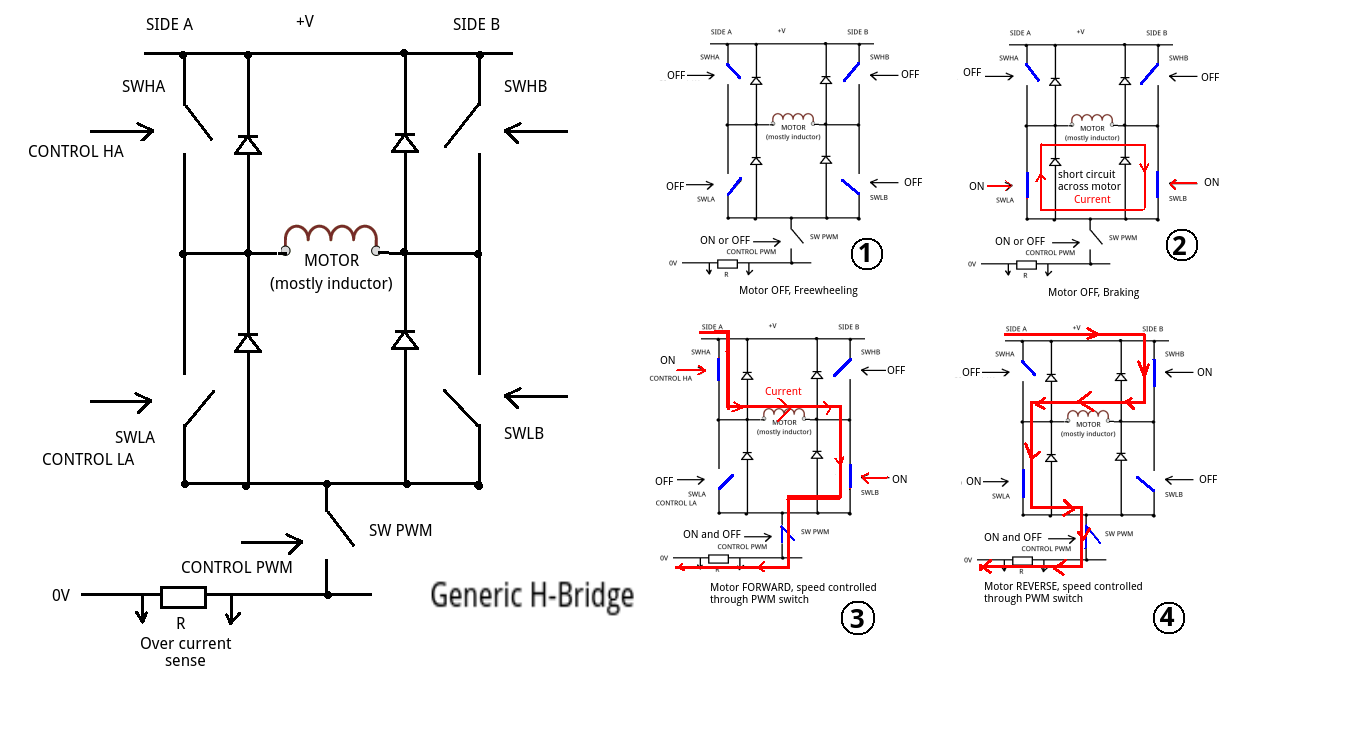
- Four switches: The H-bridge uses **four switches** (S1, S2, S3, and S4). By turning on certain pairs of switches, the direction of the current flowing through the motor is reversed:
- Switches S1 and S4: When **S1** and **S4** are ON, current flows from the power supply through the motor in one direction, making the motor rotate in a certain direction.
- Switches S2 and S3: When **S2** and **S3** are ON, the current flows in the opposite direction, reversing the motor's rotation.
- D1, D2, D3, D4: **Diodes** protect the circuit from the back EMF generated by the motor when it stops or reverses direction.
✨ Key Features ✨


Functional Description
- 🔄 Bidirectional Control: Seamlessly switch between forward and reverse motor rotation.
- 🛠️ Speed Regulation: Use Pulse Width Modulation (PWM) for fine-grained control over motor speed.
- ⚙️ Efficient Design: Built using MOSFETs or BJTs for optimized performance, making it ideal for both low-power and high-power applications.
⚙️ Why Learning H-Bridge Circuits is Important? ⚙️
Understanding H-Bridge circuits is crucial for anyone involved in electronics, robotics, or embedded systems development. Here's why:
-
🚗 Bidirectional Motor Control
- H-Bridge circuits enable you to control DC motors in both directions, making them fundamental in robotics, automated systems, and electric vehicles.
- They provide the ability to move forward and reverse, offering more versatility in your projects.
📚 Tutorials on this Topic
- SparkFun: H-Bridge Basics
- Electronics Hub: H-Bridge Motor Driver
- RobotShop: DC Motor Control
- All About Circuits: H-Bridge Theory
- Texas Instruments: H-Bridge Fundamentals
📚 Additional Resources
A list of things: - [X] Googley Eyes - [X] Tesco Clubcard - [ ] The Elizibeth Line - [ ] Beans on Toast - [ ] My Current AccountCollapsable Title
Put Content Here

H-Bridge Circuit Diagram
🛠️ Applications
- 🤖 Robotics
- 🚗 Electric Vehicles
- 🏭 Automation Systems
.gif)